By Simon Burton
Not long ago, if you asked most people in a professional services firm what a business research team does, you'd get a fairly narrow answer: they pull together background on a prospective client before a meeting, they track competitors, they answer the odd ad hoc question from a partner. Useful, but reactive. A support function.
That description is increasingly out of date, and CB Resourcing sees the shift play out firm by firm as we recruit into this space across law, consulting, and financial services. Business research has moved from answering questions to generating them. It has gone from reactive lookup to a genuinely strategic function, one that shapes where a firm invests, who it targets, and how it wins work.
None of this is entirely new, and firms are at very different points on the journey. Some have been building research products for years. Others are only now separating research out from a general business development or marketing remit. But the direction of travel is consistent, and it's accelerating.
From answering questions to building products
Most research teams still spend a good part of their time responding to requests, and that isn't going away. Partners will always need someone to pull together background before a meeting or answer a question quickly. What's changed is where the growth is. The firms getting the most value are the ones building a strategic layer alongside that responsive work: research products, recurring, structured outputs that exist independently of any single ask, and that the firm can use again and again.
That might be a quarterly sector briefing that goes out to an entire practice group before it lands in front of a single client. That's still worth doing well, and plenty of firms get real value from it. The more interesting examples we see go further, things like combining internal data, matter history, client relationships, past pitch activity, with external signals, filings, funding announcements, leadership moves, to actively flag M&A activity before it's public knowledge. That's a genuinely different kind of product: not a summary of what's already known, but a live system built to surface what a partner wouldn't otherwise have spotted in time to act on it. It might be a standing watch list on a set of target accounts, updated continuously, that flags the moment something changes. It might be a competitor tracker that doesn't just log who's doing what, but actively surfaces where the firm has a genuine right to compete and currently isn't.
The distinction matters. A one-off answer serves one person for one moment. A research product serves the whole practice, continuously, and it starts to do something a one-off answer never can: trigger action the firm wouldn't otherwise have taken.
But the product itself is only half the story. The strategic research teams we see are not sitting apart from the business waiting for a brief. They're in the room. They sit in BD meetings, they engage directly with partners, and they take the initiative to identify what research will actually drive value for the firm rather than waiting to be told. That proactive posture, being embedded in how the firm goes to market rather than serving it from a distance, is as much a part of the shift as the products themselves.
Where the strategic value actually shows up
We see this play out in a handful of consistent ways across the firms we work with.
Triggering business development interventions. A well-built research product doesn't wait to be asked. It surfaces a signal, a client restructuring, a sector regulation shifting, a competitor stumbling, and prompts a partner to pick up the phone before the opportunity is obvious to everyone else. That's the difference between BD being reactive to client requests and BD being proactive because research told them where to look.
Informing clients and demonstrating understanding. Clients can tell the difference between a firm that has read the brief and a firm that understands their business. Deep research, brought into a pitch or a relationship meeting, is what signals the latter. It's not enough to know what a client does. The firms winning are the ones who can speak to what's actually keeping that client's leadership up at night, because their research function has done the work to find out.
Positioning partners as experts. Thought leadership only works if it's actually informed. A partner writing on a sector trend backed by genuine research, not a generic take, is what builds a market reputation that clients notice and instruct on the back of. Research teams increasingly sit behind the firm's external voice, not just its internal preparation.
Identifying gaps. Where is the firm underrepresented in a growing sector? Which competitors are winning work the firm should be pitching for? Where does the client base suggest an adjacent service line the firm hasn't built yet? These are strategic questions, and they're increasingly answered by the research function rather than left to instinct at partner level.
Informing firm strategy. At the most mature end, business research feeds directly into decisions about where the firm invests: which sectors to grow into, which to exit, where lateral hires would move the needle, where the market is heading before it's obvious in the numbers. That's a seat at the strategy table, not a desk in the library.
The quick wins firms don't expect
Here's what we consistently hear from firms building this kind of capability for the first time: they expect a slow burn, and instead they find quick wins almost immediately.
The reason is simple. Most firms already have partners generating business development activity off instinct, relationships, and whatever information happens to land on their desk. The moment a proper research function starts feeding that activity with structured, timely insight, the return is visible fast. A pitch that lands because it demonstrated real understanding of a client's market position. A target account that gets engaged three months earlier than it would have been because a signal was caught. A partner positioned in front of a journalist or a conference panel because the research existed to back up the point they wanted to make.
Those early wins tend to accelerate rather than plateau. Once partners see research directly driving business development outcomes, demand for it grows, the function gets more resource and more access, and the quality of what it produces compounds. Firms that treat this as a startup investment, expecting a slow ramp, are often surprised by how quickly it pays for itself once it's properly resourced and given real access to the practice.
What AI changes, and what it doesn't
AI has made the mechanical parts of research faster. Pulling together a first pass on a company, a sector, a market, work that used to take a day can now take an hour. That's real and it matters. But it has also shifted where the actual skill in this profession sits.
The valuable part of business research was never really the retrieval, and AI has made that even more obvious. There's no value in a research team spending its time summarising and telling partners things they already know. The real skills now are curiosity and the ability to frame the right questions, the ones that lead somewhere genuinely useful, genuinely unique, that a partner couldn't have got by asking an AI tool a generic prompt themselves. That takes enough tacit knowledge of an industry to know what a good answer actually looks like, and enough curiosity to keep pushing past the obvious first answer to the insight that's actually worth having. AI can produce an answer to almost anything quickly. It can't tell you which question is worth asking, or notice that a plausible looking output is missing the one detail that matters to that specific client relationship. That judgement still sits with the researcher, and it's becoming more valuable precisely because the mechanical work around it has got cheaper.
We've watched this play out clearly at KIMRA, our knowledge and research conference, year on year. In the earlier years, most of the research teams in the room were still experimenting: testing tools, working out what AI was actually good for, figuring out where it could be trusted. More recently that's shifted. The strongest teams now aren't experimenting any more, they're operating as genuine experts, using AI to clear the mechanical work fast so they can spend their time on curiosity, framing, and the insight that actually changes what a partner does next.
The next evolution: connecting the sources
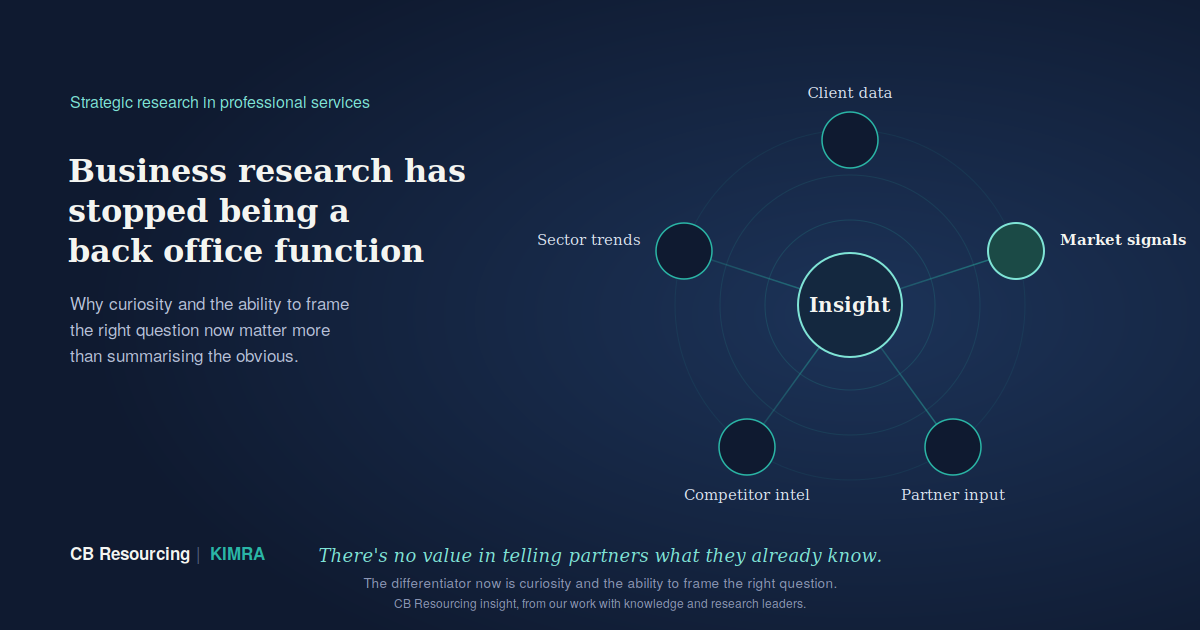
The next shift already visible on the horizon is around integration. Tools like MCP are starting to let research and knowledge systems connect directly into a firm's actual sources, client data, market intelligence platforms, internal knowledge bases, rather than research sitting as a separate, manually stitched together process. Where that goes, and how far firms take it, is still an open question. We're watching it closely rather than claiming to know the answer, but it looks like a further step in the same direction of travel: research becoming more embedded in how a firm actually operates, not less.
Why this matters for how firms hire
Firms still need people who are genuinely skilled at core research and database work, that foundation hasn't gone away and it isn't going to. What's changed is that it now sits alongside a growing strategic layer on top of it. The people driving that layer combine genuine research rigour with commercial instinct: the ability to read a signal and know it matters to a specific partner's pipeline, the confidence to package findings as something a partner will actually act on, and the tacit industry knowledge to frame the right question before reaching for any tool. That's an additional hiring brief on top of the traditional one, not a replacement for it.
That's the profile CB Resourcing looks for when we search for business research leaders and teams: not just people who can find information, but people who understand how a professional services firm actually wins work, and who can turn research into something partners use rather than file away. It's also a theme we track closely through our work with KIMRA and our wider knowledge leadership network, since the strongest business research functions we see are rarely working in isolation from the firm's broader knowledge and AI strategy.
If you're looking to discuss a business research, market intelligence, or insights vacancy, we'd welcome the conversation. Contact our team.