By Simon Burton
For information on KIMRA Conference visit the website, we also host the KIMRA Conversations Podcast. If you'd like to discuss a strategic KM hire or our networks, contact us.
For a long time, knowledge management sat quietly in the background of professional services firms. It was the function that organised precedents, tidied up the intranet, and made sure the right template was easy to find. Useful, but rarely strategic. Rarely a seat at the table.
That world is gone.
CB Resourcing has decades of combined experience recruiting specifically into knowledge and information roles across law, consulting, and financial services. Through the searches we've run, the heads of KM we've placed, and the conversations we have every week with heads of knowledge across the market, we've watched this function move from the periphery to the centre of firm strategy. And nowhere is that shift more visible than in AI.
KM leaders are the custodians of a firm's most valuable asset
In professional services, a firm's real IP isn't sitting in a brand or a building. It's sitting in the collective experience of its people: the precedents, the deal structures, the advice given, the lessons learned on hundreds of matters and projects that never quite get written down properly. Knowledge management is the function responsible for turning that tacit, scattered expertise into something the firm can actually use, protect, and increasingly, sell.
That's the productisation story. Firms are no longer content to let their IP live in individual heads or buried folders. They want to package it: into fixed-fee products, into internal tools, into client-facing offerings. None of that is possible without a KM function that understands both the substance of the work and how to structure it. That's a genuinely commercial capability, not an administrative one.
The other half of the story: KM is now central to AI enablement
The second, and arguably faster moving, shift is AI.
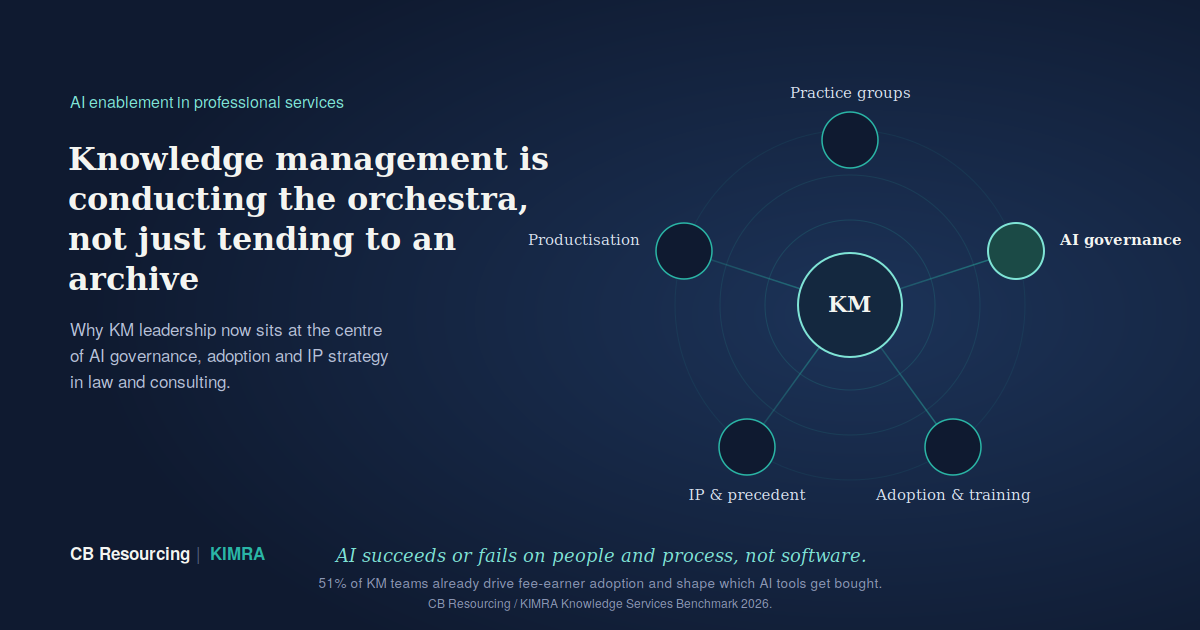
Every professional services firm is under pressure to show real returns from its AI investment. And the firms getting there aren't the ones with the flashiest tools. They're the ones with the strongest knowledge foundations underneath those tools. AI is only as good as the knowledge it's trained on, connected to, and governed by. That puts KM leaders in an unusual position: they are simultaneously the people best placed to drive adoption on the ground with fee earners, and the people who need to own the governance that makes AI outputs trustworthy, defensible, and actually usable.
We ran our own benchmarking study of knowledge services leaders this year, 47 senior respondents across law, consulting, and professional services firms, and it puts numbers behind something we'd been hearing anecdotally for a while. KM's footprint in AI is enormous at the operational level: 77% of KM teams are implementing AI tools directly, 57% sit inside cross functional AI governance groups, and 51% both influence tool procurement and actively support fee earners with adoption. This is not a function on the sidelines of the AI conversation. It is, in most firms, doing the actual work.
What's striking is the gap between that footprint and formal ownership. Only 9% of the firms in our survey have handed KM the strategy itself. That sits mostly with dedicated AI teams, innovation functions, or cross functional committees. So the honest picture is this: KM leaders are already the people implementing AI, governing its use, and supporting adoption at the coalface, but they rarely hold the pen on strategy. As one professional services respondent put it to us: "AI is removing the long standing barrier of staff needing to find time to document their expertise. Yet the true effectiveness of these systems still depends on the core competencies of KM professionals: curation, validation, stewardship, and governance. Rather than replacing these skills, AI amplifies their impact."
That's the tension firms need to resolve. Not by asking KM to fight for a strategy mandate it may never formally hold, but by recognising that the quality layer underneath the strategy is arguably where the real returns are won or lost. 72% of our respondents named knowledge curation and QA as their main focus for the next few years, and 62% said critical thinking and AI output validation is the top skill they now need to build in their teams. That's the job. It isn't a side project bolted onto KM. It is what KM leadership now means.
Where firms are leaving value on the table
Our survey also surfaced something firms should take seriously: a clear gap between what firms say is a priority and what they are actually doing about it, on tacit knowledge specifically. 72% of respondents told us tacit knowledge capture is critical or very important. But the median team is running just two of seven common capture approaches, and among law firms specifically, half are running zero or one. That's despite the fact that law is a sector whose entire commercial model depends on transferring partner expertise from one matter to the next. Investment in this area has been largely static too. 47% report no change in focus over the past two years.
None of this is a knock on the individuals doing the work. As one law firm respondent told us, quite bluntly: "Knowledge has never been a 'burning platform' and so has not attracted much scrutiny. There are always more urgent issues to address." That's precisely the point. If tacit knowledge capture never becomes urgent, it never gets resourced, and firms keep losing IP the moment senior people leave or move on, right at the point when AI tools depend more than ever on that knowledge being captured in the first place. We will be discussing this at our next Knowledge Leaders Network roundtable discussions which are held in both European and US timezones.
What we're seeing in the data on structure
Beyond the placements themselves, our benchmark gives us something genuinely rare: real data on how KM functions are structured across the market, and how that structure relates to influence. Standalone functions and those aligned to Operations report meaningfully better executive understanding of what KM does than those buried inside IT or Business Development. In our sample, standalone functions and Operations aligned ones were far more likely to also hold real AI strategic input, while none of the IT aligned KM functions in our survey claimed any strategic leadership over AI at all. Sitting in IT, in other words, does not buy a seat at the table.
Interestingly, only one of the 21 law firms in our survey aligns KM directly to the fee earning legal practice itself. The traditional picture of Professional Support Lawyers reporting up through a partner level knowledge lead is largely absent at a functional level. Team sizing tells a similar story of genuine variation rather than convention: a tenfold increase in fee earners brings only a three to four fold increase in KM headcount, and organisation size explains less than a third of the variation we see in team size. The rest comes down to alignment, sector norms, and how much backing the function actually has.
We present findings from this research every year at KIMRA, our industry leading conference for knowledge and research leaders, which now brings together over 100 KM and research leaders from across professional and financial services. Combined with the roundtables and networks we run throughout the year, it gives us a knowledge leadership network that we don't believe is matched anywhere else in this market.
The questions I'm asked most often are about where KM should fit in
Almost every conversation I have with a managing partner, COO, or CEO eventually gets here. Should KM report to the COO? To a practice head? Should it sit under IT, or under a Chief Innovation Officer? What title should the leader actually hold: Head of KM, Director, Chief Knowledge Officer?
All fair questions, and firms genuinely agonise over them. But they're the wrong questions to start with.
Knowledge management is a behaviour change programme. Its success doesn't depend on where a box sits on an org chart. It depends on whether your busiest, most senior fee earners actually change what they do day to day. They need to contribute knowledge back into the system, engage with new tools and processes, and trust what the function produces enough to rely on it. Without that participation, no amount of technology or investment delivers the results firms are looking for. This is a people and process problem before it is a structural one.
Our data backs this up in a roundabout way. Where KM sits doesn't just correlate with a title, it appears to constrain what the function is even allowed to claim. The firms where KM has real strategic standing on AI are disproportionately the standalone or Operations aligned ones, not the IT aligned ones. So structure clearly matters, but not because one reporting line is inherently correct. It matters because some structures come bundled with more genuine authority and executive access than others, and that authority is the thing KM leaders actually need.
Which means the real question is: does this person have what they need to get things done?
That's a function of authority, access, and support, not of a specific reporting line or job title in isolation. A brilliant KM leader reporting into the right sponsor, with genuine backing from firm leadership, will outperform an equally brilliant KM leader with a grander title but no real mandate. The title and the line matter only insofar as they buy credibility with partners and practice heads, and unlock the budget, time, and priority the role needs. Get those in place, and the org chart question mostly answers itself.
Budget is part of that authority, and it deserves its own mention. If KM's funding sits inside another department's budget, competing every year against that department's own priorities, it will lose more often than it wins. It becomes an afterthought, the first line trimmed when someone else's number needs to look better. KM needs its own budget, one that isn't at the mercy of whichever function happens to host it. Firms that get this wrong end up with a KM leader who spends more energy defending their funding than actually running the function.
One head of KM told us recently that other departments in her firm have started aligning their own projects to KM, not because governance requires it, but because it's genuinely the only way to get things done. That's a telling signal. It means the function has become the de facto integration point for change across the firm, whether or not the org chart reflects that.
It's also why KM leaders need to remain at the table, particularly on AI. There is a huge amount of noise in this market right now, every vendor, every consultant, every internal team pitching the next capability. The people who actually understand what a firm's IP looks like, how it's structured, where the gaps sit, and what good looks like for a given practice area are, more often than not, the KM leaders themselves. Leave them out of the room and new AI initiatives tend to launch well and then quietly stop being used within a few months. Keep them in the room and initiatives are far more likely to actually embed into how people work, rather than sit as a shiny pilot nobody returns to.
Time, incidentally, is the constraint firms consistently underestimate. 77% of the leaders we surveyed named time and bandwidth, not budget, as the top barrier to AI upskilling across their teams. Only 15% pointed to limited budget. If firms want KM to deliver on adoption and governance, the scarce resource to protect isn't the licence fee. It's the hours of your busiest people, KM and fee earners alike.
What we tell every client is this: treat the KM leadership hire as you would any other business critical leadership appointment. Give them proper executive sponsorship. Make sure the mandate is understood and respected across the partnership, not just in the business services function. And be honest that this is not a role that ever finishes. New IP is generated every single day, new AI capability arrives every quarter, and the job of turning that constant flow into something the firm can use, govern, and build on is genuinely never done. It's less like filing a cabinet and more like conducting an orchestra that never stops playing.
Getting this hire right
CB Resourcing works with firms across law, consulting, and financial services on exactly this challenge, defining what the role needs to achieve before defining what to call it, and finding leaders who can operate at the intersection of knowledge, technology, and AI governance. If you're thinking about how KM should be structured in your firm, or you're looking for the person to lead it, we'd welcome the conversation. And if you lead a knowledge or research function yourself, we'd love to have you at KIMRA and as part of our ongoing benchmarking research.